The single-line diagram tool that does the drafting.
Single-line diagrams, free in your browser. Start drawing with no account. When the job needs a stamped fault current study or arc flash labels, our engineers take it from your drawing.

Single-line diagrams, free in your browser. Start drawing with no account. When the job needs a stamped fault current study or arc flash labels, our engineers take it from your drawing.

You add the equipment; the app does the drafting. The electrical model is the source of truth, so the drawing, the schedules and the PDF always agree.
Go to the editor and start drawing. No account, no download, no template to buy. Your drawing stays in your browser until you sign up to save it.
Drag a utility, transformer, switchboard, switchgear, panelboard or MCC onto the sheet. Select a bus and press “+” to add a breaker, feeder and the equipment it feeds in one step.
Ratings, voltages and conductor sizes are filled in with defaults you can overwrite. Feeders are sized from the breaker rating. Tidy Up lays out the sheet; every wire is horizontal or vertical.
Download a vector PDF with a title block and your firm’s logo, and CSV schedules for the estimate. Sign up with an email to export a PDF or CSV, save projects and keep revisions.
Every object on the sheet is a piece of electrical equipment with ratings, terminals and feeders. Move it, rename it, re-sheet it: the connections stay put.
Utility, transformers, switchboards, switchgear, panelboards, MCCs, motors, VFDs, generators, transfer switches, breakers, fuses, disconnects, feeders and busway. Each carries its ratings.
Conductor, neutral, ground, raceway and raceway size follow the breaker rating from a built-in feeder schedule. Change the breaker and the feeder follows. Copper by default, or aluminum when you choose it. Sizes come from a standard pick-list.
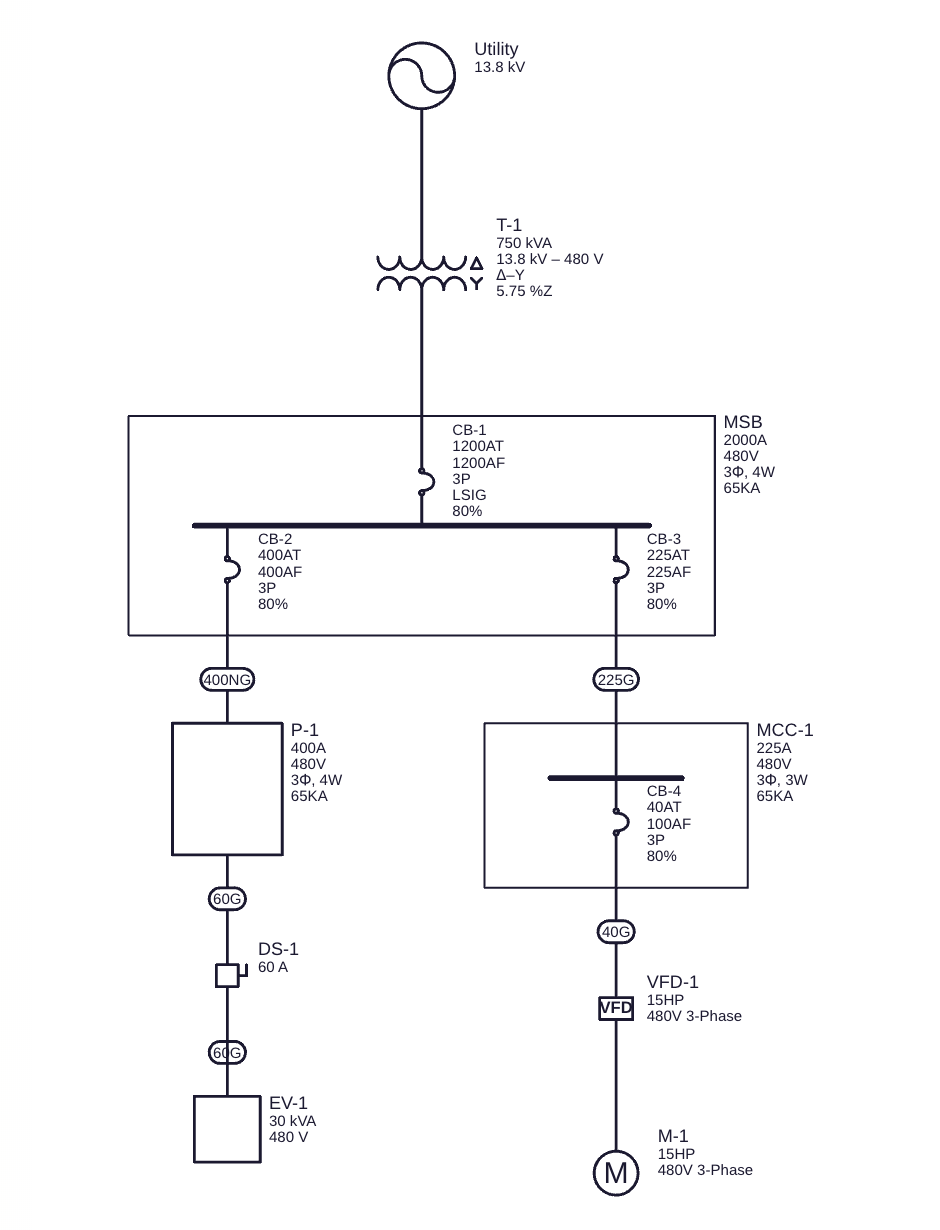
Breakers print name, trip, frame, poles, trip unit and rating. Gear prints bus rating, voltage, phase and wires. Feeder type codes sit in ovals with the schedule table placed on the sheet.
ANSI-style single-line symbols, orthogonal routing and automatic layout. Move things around freely; the electrical connections never change.
Voltage mismatches, unconnected terminals, missing ratings and code warnings, such as a conductor too small for its breaker or an undersized ground, show up in an Issues list next to the drawing, not after the print.
An equipment schedule you can edit in a table view, the feeder schedule and an issues list, exported as CSV for the estimate.
ANSI A to E and ARCH A to E1 sheet sizes, a title block with company, drawn by, date and revision, searchable text, and your logo on every sheet. No watermark; a small “Drawn with oneline.build” line in the margin can be turned off.
Autosave, undo and redo, and revisions you can restore. With a free account your projects are kept and shared with your workspace.
A first look computed from the values in your model, some of which are oneline.build defaults. Enter the utility’s available fault current and X/R ratio; feeder lengths, transformer impedance and motor data start from defaults you can overwrite. The editor computes a Preliminary Three-Phase Symmetrical Fault Current at each bus, with the contributions of utilities, generators and motors, and shows it beside the bus. It is free; an email sign-up is needed to run it.
Not a short-circuit, arc flash or coordination study, and not a replacement for a complete engineering study by a licensed professional engineer. Values it cannot fill, such as the utility’s fault current, are asked for by name rather than guessed. For anything beyond a first look, request a study. Request a quote.
oneline.build makes the drawing part fast and free. When a project needs a real study, our engineers take it from the drawing you already built. Every study is quoted for its scope.
What the free tool does, where its values come from and where it stops.
Yes. Drawing, saving, PDF and CSV export and the preliminary fault current are free today. oneline.build also quotes stamped fault current studies and arc flash studies and labels for projects that need them. If we ever introduce charges, we will tell you first and you can export your drawings before they apply.
Not to start. Open the editor and draw; your drawing is kept in your browser. An email sign-up is needed to export a PDF or CSV or run the preliminary fault current, and to save projects and add your logo. Your drawing comes with you.
Utility services, transformers, switchboards, switchgear, panelboards, motor control centers, motors, VFDs, generators, transfer switches, circuit breakers, fuses, disconnects and fused disconnects, cable feeders and busway. Switchboards, switchgear, panelboards and MCCs hold their own buses and breakers, so a feeder leaves a real breaker on a real bus.
They are starting defaults filled in for speed: voltages copied from upstream, breaker and bus ratings, conductor sizes from a feeder schedule keyed to the breaker rating, transformer impedance from a reference table. Anything you type replaces the default. Feeder lengths for the fault current start from defaults by what the feeder serves. Values with no sensible default, such as a generator’s reactance, stay blank until you enter them. The utility’s available fault current shows a placeholder on the drawing, and the fault current calculation will not run until you enter the utility’s value and X/R ratio.
It is a first look computed from the values in your model, some of which are oneline.build defaults. It is labelled preliminary with its limitations every time it is shown. It is not a short-circuit, arc flash or coordination study, and not a replacement for a complete engineering study by a licensed professional engineer. It must not be used to select equipment, set protective devices or make labels.
PDF for the drawing, on ANSI A to E and ARCH A to E1 sheets with a title block, searchable text and your logo. CSV for the equipment schedule, feeder schedule and issues list. The underlying model is structured so it can be handed to engineering study software later.
Yes. Upload a PNG or JPEG logo once for your workspace and it appears in the title block of every sheet on screen and in the PDF.
ANSI-style single-line symbols in the North American one-line convention: the AC source, coil transformer, bus, breaker (fixed and drawout forms), fuse, disconnect, transfer switch, generator, motor and VFD. Drawings print clearly in black and white.
Use Request a quote in the tool, or the form on this page. Tell us about the project and, if you like, share your oneline.build project link. A licensed professional engineer reviews it and replies by email with a quote; every study is quoted for its scope. If drawings are needed, we send a secure link for them. The study is a separate engineering service; the free tool never produces one.
Stamped fault current studies, and arc flash studies with equipment labels, by a licensed professional engineer. Tell us about the project and we reply by email with a quote. Every study is quoted for its scope. Stamped studies are sealed by a professional engineer licensed where the project is.
Free, in the browser. Start drawing with no account; sign up with an email when you are ready to export a PDF or CSV or run the preliminary fault current.
Try it now